From Servants to Stewards (II)
Design-led innovation in the public sector, in four parts: Part I · Part II · Part III · Part IV.
Many of the experts I read on the subject of design-led innovation in government don’t hide their excitement about the almost revolutionary potential of the strategy and method to transform government and our relationship with it.1 United States Digital Service affiliated coders and designers refer to themselves with only a smidgen of irony as the “Rebel Alliance”, or have official titles like “Rogue Leader.” They’ve coined the term “bureaucracy hackers” in order to better describe the scope of their work. For many though, myself included, the optimism and hope for an improved system that might transform our political life gives way rather quickly to both the memories from my lifetime (born early in Reagan’s first administration…I’m just at the cut off of “millennial”), and historical movements preceding even the lives of my grandparents, based on a promise of change that never seemed to materialize.
Sometimes when it did, it brought on nothing short of the most calamitous events in modern human history. That said, the concept of design in government, albeit in a very top-down and imposing form, has a troubling past. I want in this section to understand the distinction between the demand for and implementation of design-led innovation in government, and link it to past strategies used to improve the effectiveness of the public sector. I also discuss, and uncovered a tension between, the ethos underlying the development of technology and the assumptions we have about politics and government.
The era in which we find ourselves now has dramatic similarities to another time in U.S. and global history, but probably not the one you might expect. At that time, the effects of globalization, moneyed interests influencing powerful political parties, and the normalization of technology and machines in the lives of regular citizens demanded the evolution of government, and gave birth in the U.S. to a proto-version of the federal government apparatus we have now. The year? 1910. The industrial revolution after the Civil War had made a ton of money for a new class of economic elites,2 but relied on workers who toiled in agonizingly poor conditions in urban shops and in factory towns located throughout the states. The creation of so much wealth, and the availability of so many inexpensively produced goods demanded that the government open new markets and reduce the transaction costs of getting products to market, both domestically and abroad.
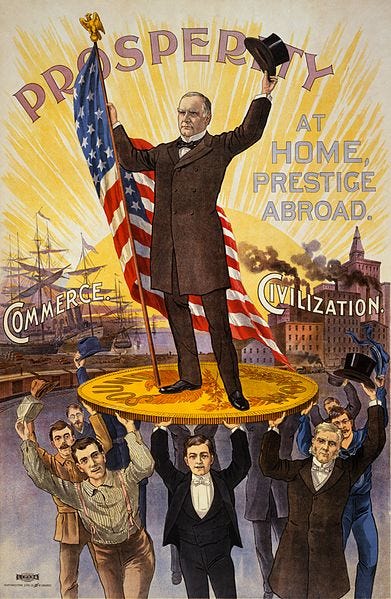
The idea of “progress” and the civilizing force of government, whether applied to the “savages” in a far away land, or exploited immigrants at home, had fueled the economy and the ambitions of a world still very much ordered by the tenets of imperialism. Even the young nation of Brazil displayed the slogan “Order and Progress” on its flag. This nod to the positivism that reigned amongst the global intelligentsia reflects the firm belief that through science we could make order from chaos as we would a create the architecture and gradual refinement of a machine. As you can imagine, many of those most affected by the push for “progress” had strong feelings on the matter.

President Theodore Roosevelt emerged during this era as one of the great spokesman for reform. A two-time president whose achievements included among other things the establishment of the National Park Service as well as overseeing the U.S.’s emergence as a global power to rival the aging empires of Europe, he became a founding voice of the new progressive moment, saying in a speech in Kansas, “I stand for the square deal. But when I say that I am for the square deal, I mean not merely that I stand for fair play under the present rules of the game, but that I stand for having those rules changed so as to work for a more substantial equality of opportunity and of reward for equally good service.” While not the beginning of a changing role for government per se, Roosevelt’s words suggest a larger shift in a government that would double down on regulation to protect workers from the most egregious abuses of government. The birth of the graduated income tax in 1913, following the ratification of the 16th amendment, represented a deepening of the relationship between the citizens and government, who prior to the income tax had no knowledge of how citizens made their money and the amount they had.3
While progressivism at its roots had laudable goals, it engendered various “social design” movements that corresponded closely with positivism. From the largely innocuous but ultimately misguided, overreaching, and troubled by unexpected consequences, like prohibition and the massive surge in organized crime that resulted, to insane and dangerous, like eugenics, ideas about how to design a new society abounded in parallel to the acceleration of the growth of the federal government. The Great Depression, while catastrophic for so many, shifted some of the attention in the U.S. from moral and social endeavors to the far more real economic needs of the people, and resulted in expansive public works programs under FDR that essentially disguised huge income redistribution projects. In Europe, however, no similarly ambitious shift occurred, and Germany and Italy especially saw the rise of demagogues who brought a message of making the trains run on time and the grand nationalistic vision that heavily emphasized ethnicity, with results that we all know.
By the end of World War II, two major world powers remained on the scene, both based squarely on the the most valuable political tool of the time, birthed during WWI but finally coming of age: the bureaucracy, in which many important decisions, and the capabilities for carrying them out, rested in the hands of public managers and teams bounded by areas of expertise, rather than the elected officials. The bureaucracy had acquired a more farther reaching mandate than ever, as evidenced by the establishment of the National Health Service in the U.K. and the New Deal reforms of FDR. Meanwhile, in the U.S.S.R, and soon after in China, the bureaucracy would be used to not only provide various services for citizens, but would be central planner for agricultural and industrial economies, an administrative mandate that the world had never seen before. The U.S. economy soared in the post-war era, so few complained at home. It seemed that everyone benefited from what Eisenhower called the military-industrial complex, itself a decades long domestic stimulus program.
What some would call the epitome of achievement of the U.S. federal government began under Kennedy and finally came to fruition years after his death: the call to put a man on the moon. Never before had anyone coordinated such a diverse array of departments and resources to a single endeavor, and it served as proof that the U.S.’s form of administration could achieve more than command-control communism. Unfortunately, by the time the man actually made it, the U.S. had weathered some of its most stressful years, as the civil rights movement and public antipathy toward the Vietnam War heightened. The same year as the moon landing, Nixon remarked:
“We face an urban crisis, a social crisis–and at the same time, a crisis of confidence in the capacity of government to do its job. A third of a century of centralizing power and responsibility in Washington has produced a bureaucratic monstrosity, cumbersome, unresponsive, ineffective. A third of a century of social experiment has left us a legacy of entrenched programs that have outlived their time or outgrown their purposes. A third of a century of unprecedented growth and change has strained our institutions, and raised serious questions about whether they are still adequate to the times. It is no accident, therefore, that we find increasing skepticism–and not only among our young people, but among citizens everywhere–about the continuing capacity of government to master the challenges we face.”

It was the 1970’s and even within the departments of the federal government, policy and regulatory decisions were analyzed and understood in brutal, zero-sum terms that assumed only the most self-serving points of view of the actors involved, or as William Eggers and John O’Leary describe:
“Like the political theorists, the new professionals settled policy disputes in terms of interests and powers, which they subjected to rational analysis microeconomic terms, but their method was to get underneath the dispute and stated negotiating position in order to discover and work with their underlying interests.”4
By the end of the decade, President Jimmy Carter gave one of the most famous, and most sobering speeches given by an American President, saying:
“Our people are losing that faith, not only in government itself but in the ability as citizens to serve as the ultimate rulers and shapers of our democracy. As a people we know our past and we are proud of it. Our progress has been part of the living history of America, even the world. We always believed that we were part of a great movement of humanity itself called democracy, involved in the search for freedom, and that belief has always strengthened us in our purpose. But just as we are losing our confidence in the future, we are also beginning to close the door on our past.”
Meanwhile, the 1960’s counter culture had given way to communities of people who decided that mainstream society wasn’t for them. They were called the new communalists, and their guidebook for the all the tools they’d need for self-sufficiency was the Whole Earth Catalog, on whose pages appeared one of the first personal computers available on the market. Stewart Brand, founder of the Whole Earth Catalog, went on to found one of the first online communities, called The Well. Nothing short of a utopian vision for society drove Brand and his contemporaries, who would go on to found everything from Wired magazine, TED, and even Burning Man.5

As the 1970’s became the early 1980’s, an industry dominated by titans like IBM and Xerox, purveyors of computers for businesses for many years by that point, saw the technology over which they had had almost complete dominance morph and evolve in the hands of anti-establishment tinkerers in garages with a more than usual commitment to democratization of information. While the proximity to Stanford and Xerox PARC certainly helped, it’s certainly no mistake that the cradle of the next technological revolution was a stone’s throw from Haight-Ashbury, as dreamers with a hope for a world suddenly had the tools for what they believed would make that utopia a reality.
At around the time that this industry evolved and grew and laid some of the groundwork for the society we live in today, political forces created the rest of the system. The ascendance of Ronald Reagan and Margaret Thatcher also saw the widespread adoption of the neoliberal system proposed by Frederick Hayek, who had languished for years as a generally ignored intellectual in a world that favored the managed economy proposed by John Maynard Keynes. With it came not only a growing volume of world trade, slowly accelerated by emerging technology, but a completely new attitude about government, largely consistent with the neoliberal perspective. Ronald Reagan enshrined this attitude perfectly: “In this present crisis, government is not the solution to our problem. Government is the problem.” He elaborated on another occasion, famously saying, “The nine most terrifying words in the English language are: I’m from the government and I’m here to help.” The hand-wringing and soul-searching of Carter had given way to a society that decided instead to give up on government and go it alone, if only government would just get out of the way. Monbiot notes the shift very clearly:
“The mechanism of bureaucracy, from centrally planned activities like the New Deal, into an era when government action was not only viewed as less effective than a private sector solution, it was a threat to liberty itself.”6
While it may seem like a real slap in the face, he had a bit of a point. Government had more often than not failed to deliver on its promises. But Reagan’s message had a horribly damaging effect on whether we should bother to fix government or rely on it at all. As Deloitte’s William Eggers notes,
“When people stop believing in government, they stop believing in some quite fundamental things about how Society works, like paying tax for the good of everyone or obeying the rules of society–these are the natural consequences of government losing the trust of its users.”7
During the Clinton years neoliberalism stampeded forward, although not without major social interventions that had mixed success, such as welfare and criminal justice reform (there’s that pernicious word again). More importantly though, the Clinton administration saw a re-engagement with transforming and improving government in the form of the National Performance Review initiative. A less discussed but very important development appeared in the U.S. and the U.K., called the New Public Management. It provided the intellectual basis for reforming government on the basis of the best practices in business to the public sector. Suddenly, the public sector began to worry a bit more about branding, and the citizen transformed into a consumer or customer. Gone were the days of the patron-client relationship of government to citizen.
What replaced it seemed to put the entire burden onto the citizen, but making information “available” and assuming that the customer would ultimately make the rational, best decision in his or her interest. And so we ended up with everything from nutrition labels with elements none of us have heard of or only make sense with the help of often conflicting “expert” advice, to resources to “inform” about veterans’ benefits that amounted to hundreds of pages, often found across a variety of places.8 It seemed, and still often seems, as if accessing government services and making rational choices without paying a professional to help navigate a seemingly endless system requires full-time attention and a master’s degree (but at least now it’s easy to blame our educational system when people make poor choices).
By this time technology had crept into government, and in the private sector the ethos underlying the “innovation” economy that encouraged startup companies and entrepreneurship began to coalesce. Clayton Christensen introduced the world to the idea of disruptive innovation. The work of economist Joseph Schumpeter, who theorized that economies evolved based on the progress of creative destruction, reemerged. And modern industrial economies tried to make sense of the role that entrepreneurship and startups would play in driving growth.
While many laudable social enterprises emerged, the strict translation of this philosophy had mixed results in the public sector, notably Michelle Rhee’s embattled tenure as chancellor of the D.C. school district. Another notable disconnect between the new premises of innovation and a public sector organization was the Transportation Security Administration. While an early adopter of innovation strategy, soliciting ideas from throughout its organization, they subsequently destroyed any goodwill from the public by installing full body scanners that later whistleblowers revealed had in fact violated privacy as everyone feared, and offered few improvements to security. In that case as in many others, the clout of the purveyors of solutions overshadowed the commitment and good ideas of those from within.
So where do we stand now, on this bumpy road to integrating innovation, technology, and more recently design, into the government? The United States federal government spends $86 billion on digital products, mostly for technology that doesn’t really work. Government remains the top-down, bureaucratic machine that it’s been for 100 years, yet it’s trying to integrate process and infrastructure that’s fundamentally opposed to that style of working, if not outright anti-authority. As Eggers and Shalabh note:
“The organizational model in the public sector has changed little over the last century. Spawned by the factories in the nineteenth century that wanted ‘hands and legs,’ employees mostly operated in a rule-based, hierarchical system. The public sector tended to invent most things in-house. A typical response to a problem was to throw resources and experts at it and hope for the best result.”9
If anything, the public sector fails to consistently deliver on high quality technology because of the fundamental disconnect between the way government works and the best practices of designing digital products and services that solve the problems they’re supposed to. This failure to produce digital products represents a much larger theme, maybe even a symptom, of a structure created more for control, and less for outcomes that improve lives, as decades of evidence demonstrates.
Service delivery and technological infrastructure are requested and deployed using means completely antithetical to quality. “Government websites mirrored departments’ short-term orientation rather than citizens’ long-term needs. In short, government became wired–but not transformed.”10 We deploy policy and regulation onto the public every day that corresponds to this modus operandi, where the policy or requirement is detached from reality in varying degrees and there’s no mechanism in place to actually measure whether or not the intervention served to solve the original problem, and that’s assuming they understood the problem at all or chose to focus on the right one.11 More often than not, the “results” trotted out as indicators of a program’s success is the amount of money committed or the size and scale of the program itself. As Eggers and O’Leary point out:
“Instead of a sound, executable design, the goal of the legislative process is often producing a bill that can pass, that can be sold to constituents back home. Laws often aren’t subject to the sort of exacting scrutiny they deserve. Too frequently, the result is legislation that shows fundamental flaws when put to the test in the real world. The bill gets past, but the design is unworkable.”12
To those of us with agency experience, this is not unlike the “get it past the client” behavior that makes work at most agencies such a drag.
The recent film Zootopia makes an aspect of our relationship with government now very apparent.13 At one important moment, the protagonist bunny, short on time to catch a nefarious criminal, needs some information from the animal kingdom version of the Department of Motor Vehicles. Arriving at the office, dread immediately hits: sloths make up the entirety of the staff. It’s a hysterical and perfectly directed scene, but it’s built on a very pernicious trope, which we can all relate to and in fact makes the whole thing funny: the slow, ineffective government worker.
While we may only need to visit the DMV once in awhile, this perception of government, regardless of what level of government we talk about, seems kind of crummy, and while somewhat innocuous when it comes to certain kinds of government services, the issue strikes a far deeper chord when we talk about veterans unable to access important health services, or the prototypical disgruntled postal worker teetering on the edge of violence at any moment.14 The perception problem only escalates in very ugly ways from there, as in the case of law enforcement agencies on the defensive because of the perception of unwarranted violence and the additional perception of a lack of accountability (from the L.A. Riots to more present-day acts of civil disobedience and protest).15
Many ask in the wake of the recent election, did our government and elected officials fail to appropriately prioritize the real problems faced by Americans of all stripes? At the core of this question is the brand of neoliberalism advanced by economist Hayek and popularized throughout the 80’s and 90’s that has left many behind, either because of direct exploitation, or a slow disappearance of the status quo and subsequently their very identified, both of which derived from a shared understanding of the American Dream. Calls for change seem to either deflect from the real problems with imaginary menaces, or to upend the system with a more radical approach to government, or maybe even both. But can we answer the challenge instead by leveraging the system we have, or as Christian Bason asks, “how can government work to harvest the benefits of globalization while minimizing the risks and pitfalls?”16
Even now the status quo leaves a lot to be desired. In the next section I’ll discuss the varying ways that talented designers and public sector workers have tried to shake things up by implementing design-led innovation within their organization, as well as explore the diverse kinds of governments that could use design-led innovation, but in different ways and for different problems. “Most public organizations have a long way to go before they honestly can claim that they are putting citizens’ needs and their reality at the centre of their efforts,” Christian Bason said.16 But prioritizing citizens’ needs, and knowing how to understand those needs and develop solutions to respond to them, are very different things. In my research, I’ve met and read about so many incredibly committed, talented, energetic people who work in government for all of the most wonderful reasons: ability to make a difference at an immense scale, love of place or country, and the opportunity to address some of society’s most pressing problems. Nonetheless, these same people have significant doubts about the government’s ability to deliver:
“Fewer than one-third of America’s senior federal executives believe the federal government to be effective at designing public policy. Meanwhile, fully one-third of [National Academy of Public Administration] fellows told us Washington is outright poor at policy design.”17
Meanwhile, Forrester research from 2015 suggests that as the government spends billions on technology, many millions of that is on technology that people don’t even want. Efforts to share information and best practices have had little effectiveness.18 Meanwhile, perception of government has never been more mixed. And can you blame them? In Boston, whose skyline I can see out my window as I write this, government mismanagement has been the subject of countless case studies in what not to do, specifically when the Big Dig project ballooned from a $3 billion budget to $15 billion. Not only that, but the final product resulted in the death of a driver when a roof collapsed, all due to flaws directly linked to systemic failures in the construction process. So really, why should the American public believe that we can do a big project right this time? Additionally, civic engagement and participation, while noble pursuits, have similarly become confused. What started as the “3 minutes at the microphone” at a city council meeting so that the government could check a box that they got feedback has exploded by orders of magnitude with the advent of social media, in which 1 voice has become 18,000 voices. In many cases partnerships for development meet some requirement by holding a public hearing, but no real requirement exists for actually integrating the opinions and feedback that may result.
Whether you’re liberal or conservative, execution matters. And like it or not for some, we have government and we’ll always have government, and a government that works effectively is absolutely imperative to all of us. However, to continue tweaking a style of government that has persisted since WWI would be to ignore the lessons of history. Our neoliberal, digitally driven world isn’t retreating any time soon, although leaders globally may try to throw wrenches in the works to gain political points and leave us all with the bill a decade later. Hayek himself feared that authoritarianism is “likely to emerge when governments, having lost the moral authority that arises from the delivery of public services, are reduced to ‘cajoling, threatening and ultimately coercing people to obey them.’” It is incumbent on us to make a government in a world reliant on technology and deeply interconnected with other, diverse places function, rather than retreat into protectionism. But we can only survive under these conditions if we completely rethink our relationship with the state, and demand that it work differently, more effectively, more inclusively, and more empathetically. As we’ll see in the next section, there is absolutely nothing standing in the way of that reality.
Onto Part III, which discusses the ways in which changemakers have implemented the design-led innovation process. As always I’d love a conversation, so please reach out.
Plates
Footnotes
-
Bason, Christian (2010) Leading Public Sector Innovation, University of Bristol: Policy Press at the University of Bristol. Pg. 147. ↩
-
Recommended reading for understanding these folks better is The Theory of the Leisure Class by Thorstein Veblen, who coined the term “conspicuous consumption.” ↩
-
One reader noted that we’ll see another phase of this as the government goes after “dark” funds located offshore. ↩
-
Eggers, William D. and John O’Leary (2009) If We Can Put a Man on the Moon. Boston: Harvard Business Review Press. Pg. 13. ↩
-
Turner, Fred (2006)From Counterculture to Cyberculture. University of Chicago Press. ↩
-
Monbiot, George (15 April 2016) “Neoliberalism–the ideology at the root of all our problems.” The Guardian. ↩
-
Eggers, William D. (2016) Delivering on Digital. USA: Deloitte University Press/Rosetta Books. Pg. 29. ↩
-
A compelling metaphor applies here: “Governments of the past used to work as a vending machine like service providers, which offered the public standardized public services in a monopolistic manner,’ says Park Chandler South Korea’s Deputy Minister for the ministry of public administration.” Eggers, 2016. Pg. 22. ↩
-
Eggers, William D. and Shalabh Kumar Singh (2009) The Public Innovator’s Playbook, Winnipeg: Deloitte Research and Harvard Ash Center for Democratic Governance and Innovation. Pg. 113. ↩
-
Eggers, 2016. Pg. 30. ↩
-
Tim O’Reilly (2010) “Government 2.0.” ↩
-
Eggers & O’Leary, 2009. Pg. 55. ↩
-
It’s a bizarrely complex political movie, by the way. The themes of identity and inclusion in Harry Potter have nothing on this one. ↩
-
I should note here that my cousin is a postal worker. She spent many years touring with the Grateful Dead and is a very good, cool mom to a young daughter. A few our other cousins are in the military or are first responders. To all of them, work in the public sector represented a really promising and solid job opportunity. So that image doesn’t quite hold up. ↩
-
My use of “perception” here is very deliberate. Whether or not the violence was warranted or if the police officers were held accountable is secondary to the point I make here, about the power of perception to place additional stresses on the integrity of the system. ↩
-
Eggers/O’Leary, 2009. Pg 66. ↩
-
Bason, 2010. Pg. 19. ↩